

Personal Flow Cytometers
Personal flow cytometers put the power of advanced cell analysis right at your fingertips. Compact, user-friendly, and packed with capabilities rivaling core lab systems, these benchtop instruments make high-quality results accessible without the need for a dedicated operator. From plug-and-play setup to automated workflows and walk-away shutdown, they streamline your research so you can focus on discovery, not device management.read more
They can be closed systems, optimized for ease-of-use with pre-set assay kits, or open systems that allow full customization of parameters, lasers, and detection channels to match diverse experimental needs.
Their performance is heavily influenced by optical configuration: more lasers and detectors unlock more analytical power, but at a higher cost. Instruments range from affordable single-laser models to high-performance, multi-laser systems that can scale from three colors to thirteen, paired with automated sampling.
Essential Features
- Personal flow cytometers are available as closed systems with pre-set assays, enabling fast and routine workflows without the need for complex setup. Alternatively, open systems give researchers complete control over instrument parameters, laser configurations, and detection channels for fully customized experiments.
- The personal flow cytometry instruments can be equipped with multiple lasers and detectors to expand color and parameter detection capabilities. Many models feature field-upgradable designs, allowing users to add functionality as research needs grow.
- Most flow cytometry systems provide absolute cell counts without the need for counting beads. They can achieve event rates of up to 35,000 events per second and process samples at speeds of 1 ml per minute, with dynamic ranges extending up to seven decades for precise measurements.
- Advanced features include acoustic focusing for consistent sensitivity with varying sample concentrations, microfluidic platforms that require minimal sample volumes and generate low waste, and magnetic column enrichment for pre-analysis sample preparation. Some models also integrate cell sorting capabilities, enabling downstream experimentation on isolated populations.
- Designed for ease-of-use, these instruments often support plug-and-play installation and feature automated workflows for walk-away convenience. Many can be unpacked, installed, and ready for sample acquisition in less than an hour.
Applications
- Cell health analysis: Personal flow cytometry equipment enables comprehensive studies of cell viability, apoptosis, and proliferation, providing precise and reliable data for health status assessments.
- Cell signaling research: These systems are ideal for detecting pathway activation and measuring phospho-protein expression, supporting detailed investigations into cellular communication and signaling mechanisms.
- Immunology: Flow cytometry systems can facilitate immune cell profiling and surface marker detection, making them indispensable for immunophenotyping and immune function studies.
- Bacterial & microbial studies: They can be used to monitor GFP expression, evaluate cell viability, and assess metabolic activity in bacterial and microbial samples with high sensitivity.
- Rare cell analysis: Certain models can analyze as few as 1,000 cells with exceptional accuracy, making them suitable for rare and precious sample types.
- Pre-enrichment workflows: Instruments equipped with magnetic separation capabilities allow pre-analysis enrichment, ensuring higher quality results for downstream assays.
- Sorting for downstream experiments: Systems with integrated cell sorting enable the isolation of specific populations, allowing researchers to perform functional studies on targeted cells.
Showing the single result
Category
- Bioreactors+
- Parallel Bioreactors
- Single-Use Bioreactors
- Stirred-Tank Bioreactors
- Capillary Electrophoresis Instruments+
- Capillary Gel Electrophoresis (CGE)
- Capillary Isoelectric Focusing (CIEF)
- Capillary Zone Electrophoresis (CZE)
- Cell Counters and Analyzers+
- Automated Cell Counters
- Manual Cell Counters
- Cellular Imaging Systems+
- Fluorescence Imaging Systems
- High-Content Imaging Systems
- Live-Cell Imaging Systems
- Centrifuges+
- Benchtop Centrifuges
- Clinical Centrifuges
- Micro Centrifuges
- Refrigerated Centrifuges
- Ultracentrifuges
- Chromatography Instruments+
- Gas Chromatography
- Ion Chromatography
- Liquid Chromatography
- Flow Cytometer+
- Cell Analyzers
- Cell Isolation Systems
- Cell Sorters
- High-Throughput Flow Cytometers
- Imaging Flow Cytometry
- Personal Flow Cytometers
- Portable/Benchtop Flow Cytometers
- Spectral Flow Cytometers
- Laboratory Incubators+
- CO2 Incubators
- Dry Bath Incubators
- Hypoxia Incubators and Chambers
- Incubator Shakers
- Laboratory Ovens
- Portable Incubators
- Thermal Mixers
- Laboratory Microscopes+
- Atomic Force Microscopes (AFM)
- Automated Modular Microscopes
- Compound Microscopes
- Confocal Microscopes
- Digital Microscopes
- Fluorescence Microscopes
- Inverted Microscopes
- Live Cell Imaging Microscopes
- Metallurgical Microscopes
- Multiphoton Microscopes
- Polarizing Microscopes
- Raman Microscopes
- Scanning Electron Microscopes (SEM)
- Stereo Microscopes
- Super-Resolution Microscopes
- Transmission Electron Microscopes (TEM)
- Upright Microscopes (Neuroscience)
- Liquid Handlers+
- Automated Pipetting Systems
- Multi-Channel Liquid Handlers
- Robotic Liquid Handlers
- Variable Volume Pipetting Systems
- Mass Spectrometers+
- Ambient Ionization
- APCI MS
- ESI MS
- FT ICR MS
- ICP MS
- Orbi Trap MS
- Quadrupole MS
- Time-of-Flight MS
- Microarray Scanners+
- DNA Microarray Scanners
- Laser-Based Microarray Scanners
- Microplate Readers+
- Absorbance Microplate Readers
- Fluorescence Microplate Readers
- Luminescence Microplate Readers
- Multimode Microplate Readers
- Particle Counters and Analyzers+
- Airborne Particle Counters
- Laser Diffraction Analyzers
- Liquid Particle Counters
- Nanoparticle Analyzers
- Portable Particle Counters
- Remote Particle Counters
Brand
- ACCU-SCOPE
- Agilent
- Airmodus
- Alphasense
- Analytik Jena
- ARGO-HYTOS
- Arrayit
- Aurora Biomed Inc.
- Azure Biosystems
- Baker
- BD Biosciences
- Beckman Coulter
- Beijing Challen Biotechnology
- Binder
- Bio-Techne
- Biobase
- BioRad
- BMG Labtech
- Bruker
- Celestron
- Cellbox
- Centurion Scientific Ltd
- ChemoMetec
- CleanAir
- Cleatech
- Corning
- Countstar
- CS Instruments
- CUBIC
- Cytek Biosciences
- Cytena
- Cytiva
- Data Technologies
- Descase
- Electrolab Biotech
- Eppendorf
- Euromex
- Evident
- Fermex
- Fluke
- Formulatrix
- Getinge
- Gilson
- GPC Bio
- Haier Biomedical
- Hamilton Company
- Hettich
- Hitachi High-Tech
- Hudson Robotics Inc.
- Hydro
- INFORS HT
- Innopsys
- Jasco
- Jeiotech
- JEOL
- Kanomax
- Keyence
- KNAUER
- LAB-KITS
- Labomed
- Labwit
- Leco
- Leica
- Lighthouse
- Logos Biosystems
- LOSI
- Lumex Instruments
- Luminex
- Malvern Panalytical
- Meiji Techno
- Memmert
- Merck
- Mettler-Toledo International Inc.
- Miltenyi Biotec
- Molecular Devices
- Motic
- MP Filtri
- MSE (Medical and Scientific Equipment)
- NCI
- Nikon Instruments
- NuAire
- ORFLO Technologies
- Oxford Instruments
- PAMAS
- Particle Measuring Systems
- Particles Plus
- PBS Biotech
- PCE instruments
- PerkinElmer
- PharSol
- PHCbi
- Prior Scientific
- Promega
- Qiagen NV
- Revvity
- RION
- Sartorius
- SATAKE
- Sciex
- Sebia
- SETA
- Setra
- Shimadzu
- SIBATA
- Sigma Laborzentrifugen GmbH
- Solaris Biotech
- Solida Biotech
- Sony Biotechnology Inc.
- SPT Labtech Ltd
- Stratedigm Inc.
- Sysmex Corporation
- Tecan
- TES
- Thermo Fisher Scientific
- TSI
- Waters
- Western States Machine Company
- ZEISS
- ZETRON
-
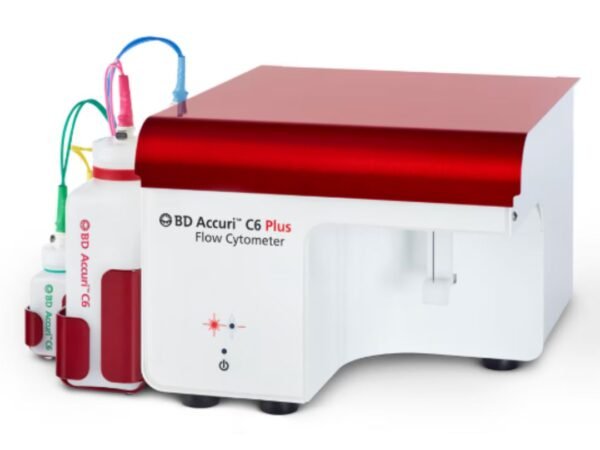
BD Biosciences BD Accuri™ C6 Plus Personal Flow Cytometer
The BD Accuri™ C6 Plus Flow Cytometer is a compact, easy-to-use instrument designed for a wide range of research applications. It offers reliable pe...