

Liquid Handling Systems
Liquid handling systems are automated platforms designed to manage the precise transfer, dispensing, and mixing of liquids in laboratory workflows. They reduce variability and human error, ensuring accuracy and reproducibility in experiments. These systems range from compact benchtop units for routine tasks to advanced, integrated workstations that support high-throughput and complex applications. By minimizing contamination risks and saving reagents, they optimize efficiency and resource use. Automated liquid handlers support a wide range of laboratory applications, from routine sample preparation to advanced multi-omics studies. They play a crucial role in accelerating scientific workflows while maintaining consistent, high-quality results.read more
Key Features of Automated Liquid Handling Systems
- Liquid handling instruments offer user-friendly software control, quick and ergonomic tip loading, automatic detection of tips, and adjustable aspiration and dispensing speeds to ensure accurate handling of various liquid types. Its compact build allows it to fit conveniently under a laminar flow hood, while an XL model is available for handling an additional plate.
- The pipettor delivers fast and accurate microplate handling, with a touchscreen interface that allows easy saving and modification of settings like volume, speed, and height. Its compact, open design accommodates SBS-standard labware and external instruments, while functions such as automatic tip sealing, preloaded tip racks, and programmable dispense patterns provide efficient, consistent, and versatile workflows.
- Certain models include a digital display that makes it simple for users to confirm the chosen volume. The volume can be adjusted with ease using a smoothly rotating knob or dial for intuitive operation.
- The systems provide precise liquid dispensing with a flexible volume range to suit diverse experimental requirements. They also enable plate reformatting, allowing sample transfers across formats ranging from single wells to 96-, 384-, and 1536-well plates.
- Automated liquid handling robots employ air-displacement pipetting with a patented lock-and-key mechanism, complemented by optional anti-droplet control and liquid-level detection for precise volume handling from sub-microliters to larger quantities. Their modular architecture supports the integration of cameras, tube transport, and diverse tools, enabling adaptable deck layouts that can hold multiple microplates or tube positions across pipetting channels.
- Multichannel pipettes feature a universal-fit tip nozzle, ensuring compatibility with a wide variety of pipette tips and enhancing workflow flexibility. They are equipped with an ergonomically designed tip ejector lever that enables smooth and effortless tip removal. This design minimizes strain during use, supporting comfort over extended periods. As a result, they maintain consistent performance even during long laboratory sessions.
Applications of Automated Liquid Handlers
- ELISA and immunoassays: Multichannel liquid equipment simplifies the addition of reagents and transfer of samples into microplates, minimizing well-to-well variability and ensuring consistent, efficient results in high-throughput immunoassays.
- Drug discovery: In drug discovery, automated systems enable high-throughput screening, letting researchers quickly evaluate thousands of compounds and efficiently pinpoint potential candidates.
- Cell culture: The systems assist with media preparation, cell seeding, and the precise addition of growth factors or drugs. Their versatility ensures accurate handling of varying liquid volumes across different experiments.
- Environmental & food testing: The systems are used for processing samples in contaminant detection, microbial analysis, and food quality assessments. Their ability to accurately transfer different sample volumes enhances the reliability of test results.
- Analytical chemistry: Variable volume pipetting systems are essential for preparing samples for techniques such as HPLC, GC, and mass spectrometry. Their precise dispensing ensures uniform sample quality and reproducible analytical outcomes.
- Flow cytometry: Liquid handlers efficiently prepare and stain cells for flow cytometry, ensuring uniform sample processing and minimizing variability between experiments.
- Nucleic acid extraction: Liquid handlers automate the isolation of DNA or RNA from different sample types, which boosts throughput while preserving sample integrity and consistency.
- Primary sample reformatting: Robotic systems streamline the transfer of primary samples into multi-well plates for further analysis, saving time and minimizing the risk of cross-contamination.
- Miniaturized screenings: Automation allows high-throughput testing in compact formats, like 384- or 1536-well plates, saves reagents, and ensures precise and reproducible results.
- Whole blood fractionation: Liquid handlers facilitate the separation of plasma, serum, and cellular components from whole blood, standardizing sample processing and minimizing variability.
- ADME-Tox studies: Multichannel pipettes enable the preparation of multiple replicates across plates for pharmacokinetic and toxicity assays and enhance the reliability and consistency of the results.
Showing 1–12 of 107 results
Category
- Bioreactors+
- Parallel Bioreactors
- Single-Use Bioreactors
- Stirred-Tank Bioreactors
- Capillary Electrophoresis Instruments+
- Capillary Gel Electrophoresis (CGE)
- Capillary Isoelectric Focusing (CIEF)
- Capillary Zone Electrophoresis (CZE)
- Cell Counters and Analyzers+
- Automated Cell Counters
- Manual Cell Counters
- Cellular Imaging Systems+
- Fluorescence Imaging Systems
- High-Content Imaging Systems
- Live-Cell Imaging Systems
- Centrifuges+
- Benchtop Centrifuges
- Clinical Centrifuges
- Micro Centrifuges
- Refrigerated Centrifuges
- Ultracentrifuges
- Chromatography Instruments+
- Gas Chromatography
- Ion Chromatography
- Liquid Chromatography
- Flow Cytometer+
- Cell Analyzers
- Cell Isolation Systems
- Cell Sorters
- High-Throughput Flow Cytometers
- Imaging Flow Cytometry
- Personal Flow Cytometers
- Portable/Benchtop Flow Cytometers
- Spectral Flow Cytometers
- Laboratory Incubators+
- CO2 Incubators
- Dry Bath Incubators
- Hypoxia Incubators and Chambers
- Incubator Shakers
- Laboratory Ovens
- Portable Incubators
- Thermal Mixers
- Laboratory Microscopes+
- Atomic Force Microscopes (AFM)
- Automated Modular Microscopes
- Compound Microscopes
- Confocal Microscopes
- Digital Microscopes
- Fluorescence Microscopes
- Inverted Microscopes
- Live Cell Imaging Microscopes
- Metallurgical Microscopes
- Multiphoton Microscopes
- Polarizing Microscopes
- Raman Microscopes
- Scanning Electron Microscopes (SEM)
- Stereo Microscopes
- Super-Resolution Microscopes
- Transmission Electron Microscopes (TEM)
- Upright Microscopes (Neuroscience)
- Liquid Handlers+
- Automated Pipetting Systems
- Multi-Channel Liquid Handlers
- Robotic Liquid Handlers
- Variable Volume Pipetting Systems
- Mass Spectrometers+
- Ambient Ionization
- APCI MS
- ESI MS
- FT ICR MS
- ICP MS
- Orbi Trap MS
- Quadrupole MS
- Time-of-Flight MS
- Microarray Scanners+
- DNA Microarray Scanners
- Laser-Based Microarray Scanners
- Microplate Readers+
- Absorbance Microplate Readers
- Fluorescence Microplate Readers
- Luminescence Microplate Readers
- Multimode Microplate Readers
- Particle Counters and Analyzers+
- Airborne Particle Counters
- Laser Diffraction Analyzers
- Liquid Particle Counters
- Nanoparticle Analyzers
- Portable Particle Counters
- Remote Particle Counters
Brand
- ACCU-SCOPE
- Agilent
- Airmodus
- Alphasense
- Analytik Jena
- ARGO-HYTOS
- Arrayit
- Aurora Biomed Inc.
- Azure Biosystems
- Baker
- BD Biosciences
- Beckman Coulter
- Beijing Challen Biotechnology
- Binder
- Bio-Techne
- Biobase
- BioRad
- BMG Labtech
- Bruker
- Celestron
- Cellbox
- Centurion Scientific Ltd
- ChemoMetec
- CleanAir
- Cleatech
- Corning
- Countstar
- CS Instruments
- CUBIC
- Cytek Biosciences
- Cytena
- Cytiva
- Data Technologies
- Descase
- Electrolab Biotech
- Eppendorf
- Euromex
- Evident
- Fermex
- Fluke
- Formulatrix
- Getinge
- Gilson
- GPC Bio
- Haier Biomedical
- Hamilton Company
- Hettich
- Hitachi High-Tech
- Hudson Robotics Inc.
- Hydro
- INFORS HT
- Innopsys
- Jasco
- Jeiotech
- JEOL
- Kanomax
- Keyence
- KNAUER
- LAB-KITS
- Labomed
- Labwit
- Leco
- Leica
- Lighthouse
- Logos Biosystems
- LOSI
- Lumex Instruments
- Luminex
- Malvern Panalytical
- Meiji Techno
- Memmert
- Merck
- Mettler-Toledo International Inc.
- Miltenyi Biotec
- Molecular Devices
- Motic
- MP Filtri
- MSE (Medical and Scientific Equipment)
- NCI
- Nikon Instruments
- NuAire
- ORFLO Technologies
- Oxford Instruments
- PAMAS
- Particle Measuring Systems
- Particles Plus
- PBS Biotech
- PCE instruments
- PerkinElmer
- PharSol
- PHCbi
- Prior Scientific
- Promega
- Qiagen NV
- Revvity
- RION
- Sartorius
- SATAKE
- Sciex
- Sebia
- SETA
- Setra
- Shimadzu
- SIBATA
- Sigma Laborzentrifugen GmbH
- Solaris Biotech
- Solida Biotech
- Sony Biotechnology Inc.
- SPT Labtech Ltd
- Stratedigm Inc.
- Sysmex Corporation
- Tecan
- TES
- Thermo Fisher Scientific
- TSI
- Waters
- Western States Machine Company
- ZEISS
- ZETRON
-

Agilent AssayMAP Bravo Protein Sample Prep Platform
AssayMAP Bravo enables scalable, automated protein sample prep for LC/MS and proteomics workflows.
-

Agilent BenchCel Workstation
The BenchCel Workstation provides rapid, automated microplate handling with scalable options for throughput and integration.
-
![Bravo_front_ZB028-1600x1600[1]](https://lifesciencestools.com/wp-content/uploads/2025/05/Bravo_front_ZB028-1600x16001-1-600x450.jpg)
Agilent Bravo Automated Liquid Handling Platform
Flexible, compact liquid handling system ideal for high-throughput workflows.
-

Agilent Bravo BenchCel Workstation
Bravo BenchCel Workstation offers seamless integration of pipetting and plate handling for optimized automation.
-

Agilent Bravo Metabolomics Sample Prep Platform
The Bravo Metabolomics platform automates sample prep steps for consistent and high-quality data output.
-

Agilent Bravo NGS
Bravo NGS platform simplifies and automates next-gen sequencing library prep for genomics applications.
-

Agilent Bravo NGS Workstation
Bravo NGS Workstation combines hardware and software to deliver a turnkey NGS library prep solution.
-

Analytik Jena GmbH+Co. KG CyBio FeliX Basic Unit with Enclosure OL5015-24-100
CyBio Felix series offers compact and modular automated liquid handling for diverse lab workflows.
-

Analytik Jena GmbH+Co. KG CyBio FeliX Basic Unit with Opaque EnclosureOL5015-24-600
CyBio Felix series offers compact and modular automated liquid handling for diverse lab workflows.
-

Analytik Jena GmbH+Co. KG CyBio FeliX Basic Unit; Clean Bench OL5015-25-500
CyBio Felix series offers compact and modular automated liquid handling for diverse lab workflows.
-

Analytik Jena GmbH+Co. KG CyBio FeliX Basic Unit; Clean Bench; with Light Curtain OL5015-25-505
CyBio Felix series offers compact and modular automated liquid handling for diverse lab workflows.
-
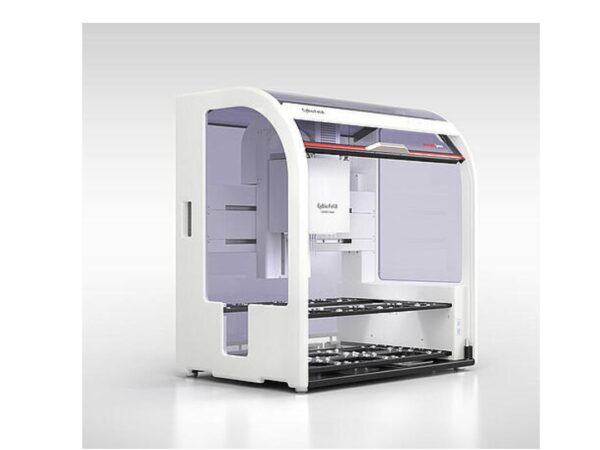
Analytik Jena GmbH+Co. KG CyBio FeliX CHOICE Workstation OL5015-20-125
CyBio Felix series offers compact and modular automated liquid handling for diverse lab workflows.