

Variable Volume Pipetting Systems
Variable Volume Pipette for Ergonomic Liquid Handling: The Best Micropipettes
Variable volume pipetting systems are advanced liquid handling tools designed to dispense liquids with high accuracy and flexibility across a broad volume range. Users can adjust the dispensed volume within a defined setting, making these instruments versatile for diverse laboratory applications. Built from lightweight yet durable materials, they provide ergonomic comfort during extended use and maintain long-term reliability.
Available in a broad range of volumes from microliters to milliliters, adjustable designs deliver precise control, reproducibility, and universal tip compatibility. Many models are fully or semi-autoclavable, supporting safe maintenance and reducing cross-contamination risk. By combining precision, durability, and adaptability, variable volume micropipettes offer best-in-class performance for routine tasks and demanding research, from small-scale assays to large-volume handling. Compared with fixed volume formats, single channel options enable consistent, traceable transfers across workflows.
Key Features of Ergonomic Pipette Design, Volume Control, and Electronic Pipettes
- Ergonomic design for comfort: Ergonomic geometry reduces hand fatigue and supports neutral grip posture for sustained use with manual pipettes.
- Precise volume control: Finely adjustable volume settings, with increments from 0.05 µL to 10 µL (depending on the model), ensure accurate and reproducible liquid handling.
- Digital display and smooth adjustment: Clear display and smooth-turning control enable rapid volume verification and intuitive adjustment during high-throughput protocols.
- Autoclavable and UV sterilizable construction: The pipettes have components that support sterile technique and minimize cross-contamination in sensitive environments.
- Durable and chemically resistant materials: Robust, chemically resistant construction (for example, polycarbonate composites) enhances durability and reliability over repeated cycles.
- Secure volume lock mechanism: A volume lock prevents inadvertent changes during repetitive dispensing, preserving consistency in single channel workflows.
- Efficient blow-out and tip compatibility: The design reduces sample retention and improves transfer fidelity across micropipettes and electronic pipettes.
- Easy disassembly for maintenance: Tool-less disassembly streamlines cleaning and routine servicing, maintaining performance without complex maintenance.
Applications: Large-Volume Precision with Manual Pipettes, Electronic Pipettes, and a Micropipette Set
- Molecular biology: The pipetting systems are widely used for the preparation of PCR reactions, DNA/RNA extraction, and sequencing workflows with precise, adjustable aliquots to protect data quality.
- Cell culture: In cell culture, these systems help in media preparation, cell seeding, and the addition of growth factors or drugs with controlled transfers that help limit cross-contamination.
- Biochemistry & enzymology: They are essential for dispensing substrates, cofactors, and inhibitors for kinetic assays requiring reproducible timing and volumes.
- Clinical diagnostics: The systems are used in standardized patient sample preparation, dilutions, and reagents for ELISA and qPCR to support traceability and comparability.
- Pharmaceutical research: In drug discovery, the pipettes are used for dose-response studies and compound dilution, supporting high-throughput screening and maintaining rigorous liquid accuracy.
- Environmental & food testing: They play a role in reliable handling for contaminant assays and microbial testing, ensuring consistent, compliant sample preparation.
- Analytical chemistry: The pipetting systems are critical for precise sample prep in HPLC, GC, and mass spectrometry, safeguarding uniform injection quality and instrumental robustness.
Showing all 2 results
Category
- Bioreactors+
- Parallel Bioreactors
- Single-Use Bioreactors
- Stirred-Tank Bioreactors
- Capillary Electrophoresis Instruments+
- Capillary Gel Electrophoresis (CGE)
- Capillary Isoelectric Focusing (CIEF)
- Capillary Zone Electrophoresis (CZE)
- Cell Counters and Analyzers+
- Automated Cell Counters
- Manual Cell Counters
- Cellular Imaging Systems+
- Fluorescence Imaging Systems
- High-Content Imaging Systems
- Live-Cell Imaging Systems
- Centrifuges+
- Benchtop Centrifuges
- Clinical Centrifuges
- Micro Centrifuges
- Refrigerated Centrifuges
- Ultracentrifuges
- Chromatography Instruments+
- Gas Chromatography
- Ion Chromatography
- Liquid Chromatography
- Flow Cytometer+
- Cell Analyzers
- Cell Isolation Systems
- Cell Sorters
- High-Throughput Flow Cytometers
- Imaging Flow Cytometry
- Personal Flow Cytometers
- Portable/Benchtop Flow Cytometers
- Spectral Flow Cytometers
- Laboratory Incubators+
- CO2 Incubators
- Dry Bath Incubators
- Hypoxia Incubators and Chambers
- Incubator Shakers
- Laboratory Ovens
- Portable Incubators
- Thermal Mixers
- Laboratory Microscopes+
- Atomic Force Microscopes (AFM)
- Automated Modular Microscopes
- Compound Microscopes
- Confocal Microscopes
- Digital Microscopes
- Fluorescence Microscopes
- Inverted Microscopes
- Live Cell Imaging Microscopes
- Metallurgical Microscopes
- Multiphoton Microscopes
- Polarizing Microscopes
- Raman Microscopes
- Scanning Electron Microscopes (SEM)
- Stereo Microscopes
- Super-Resolution Microscopes
- Transmission Electron Microscopes (TEM)
- Upright Microscopes (Neuroscience)
- Liquid Handlers+
- Automated Pipetting Systems
- Multi-Channel Liquid Handlers
- Robotic Liquid Handlers
- Variable Volume Pipetting Systems
- Mass Spectrometers+
- Ambient Ionization
- APCI MS
- ESI MS
- FT ICR MS
- ICP MS
- Orbi Trap MS
- Quadrupole MS
- Time-of-Flight MS
- Microarray Scanners+
- DNA Microarray Scanners
- Laser-Based Microarray Scanners
- Microplate Readers+
- Absorbance Microplate Readers
- Fluorescence Microplate Readers
- Luminescence Microplate Readers
- Multimode Microplate Readers
- Particle Counters and Analyzers+
- Airborne Particle Counters
- Laser Diffraction Analyzers
- Liquid Particle Counters
- Nanoparticle Analyzers
- Portable Particle Counters
- Remote Particle Counters
Brand
- ACCU-SCOPE
- Agilent
- Airmodus
- Alphasense
- Analytik Jena
- ARGO-HYTOS
- Arrayit
- Aurora Biomed Inc.
- Azure Biosystems
- Baker
- BD Biosciences
- Beckman Coulter
- Beijing Challen Biotechnology
- Binder
- Bio-Techne
- Biobase
- BioRad
- BMG Labtech
- Bruker
- Celestron
- Cellbox
- Centurion Scientific Ltd
- ChemoMetec
- CleanAir
- Cleatech
- Corning
- Countstar
- CS Instruments
- CUBIC
- Cytek Biosciences
- Cytena
- Cytiva
- Data Technologies
- Descase
- Electrolab Biotech
- Eppendorf
- Euromex
- Evident
- Fermex
- Fluke
- Formulatrix
- Getinge
- Gilson
- GPC Bio
- Haier Biomedical
- Hamilton Company
- Hettich
- Hitachi High-Tech
- Hudson Robotics Inc.
- Hydro
- INFORS HT
- Innopsys
- Jasco
- Jeiotech
- JEOL
- Kanomax
- Keyence
- KNAUER
- LAB-KITS
- Labomed
- Labwit
- Leco
- Leica
- Lighthouse
- Logos Biosystems
- LOSI
- Lumex Instruments
- Luminex
- Malvern Panalytical
- Meiji Techno
- Memmert
- Merck
- Mettler-Toledo International Inc.
- Miltenyi Biotec
- Molecular Devices
- Motic
- MP Filtri
- MSE (Medical and Scientific Equipment)
- NCI
- Nikon Instruments
- NuAire
- ORFLO Technologies
- Oxford Instruments
- PAMAS
- Particle Measuring Systems
- Particles Plus
- PBS Biotech
- PCE instruments
- PerkinElmer
- PharSol
- PHCbi
- Prior Scientific
- Promega
- Qiagen NV
- Revvity
- RION
- Sartorius
- SATAKE
- Sciex
- Sebia
- SETA
- Setra
- Shimadzu
- SIBATA
- Sigma Laborzentrifugen GmbH
- Solaris Biotech
- Solida Biotech
- Sony Biotechnology Inc.
- SPT Labtech Ltd
- Stratedigm Inc.
- Sysmex Corporation
- Tecan
- TES
- Thermo Fisher Scientific
- TSI
- Waters
- Western States Machine Company
- ZEISS
- ZETRON
-

Beckman Coulter Biomek i5 Span-8 without Enclosure B87578
Multichannel pipetting with open access design for diverse and scalable applications.
-
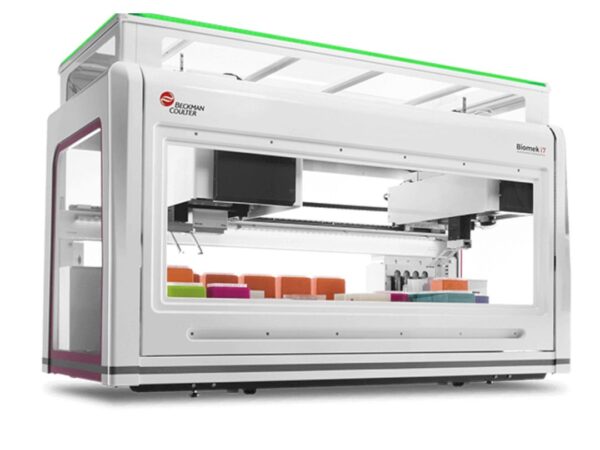
Beckman Coulter Biomek® i7 Hybrid (MC + Span-8) without Enclosure/B87579
The Biomek i7 Hybrid system merges two pipetting tools, Span-8 and multichannel, for unparalleled flexibility in labs.